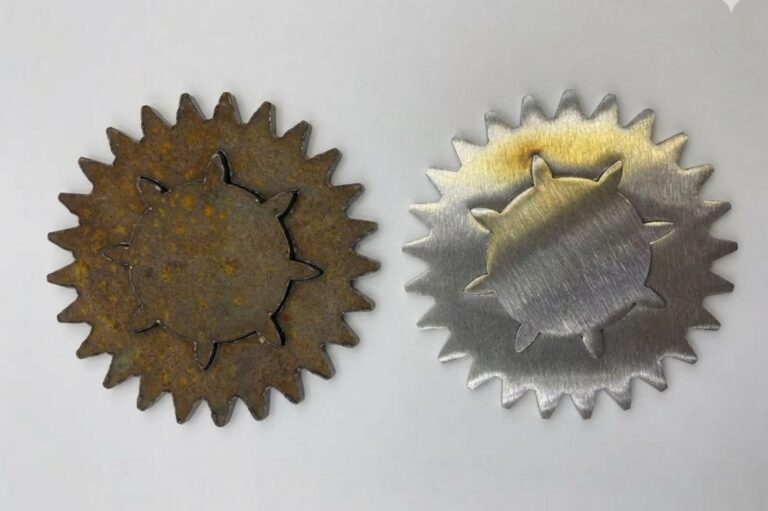
Launching such elaborate assessment about computerized devices designed focused on surface finishing offer revolutionized engineering methods, offering remarkable enhancements within swiftness and standard. Our overview examines the several types of appliances, containing brushing abrading systems, whirling mechanisms, and advanced robotic applications. We will review the merits of leveraging these systems, including cut workforce expenses, augmented output accuracy, and upgraded production rates.
Contour Chamfering Units: Accurate Finalizing Explained
Border trimming systems offer a innovative solution for securing correct enhancing on workpieces. In contrast with manual ways, these robotic tools yield consistent benefits and notably increase creation capacity. Such systems frequently adopt various grinding appliances like twisting burrs, honing rotors, or particular outlines to remove sharp profiles and roughness. These method is crucial in a broad variety of domains, featuring vehicle and instrumentation.- Improve component appearance
- Cut creation fees
- Amplify turnover and functionality
Residuum Discharge Mechanisms: Gaining Unblemished, Exceptional Exteriors
Present-day metal processing routines predictably yield significant amounts of impurities, a byproduct that, if remaining, can severely impair the quality of the production. Fortunately, advanced slag removal machines offer a steady solution. These focused machines, employing techniques like buffing, are designed to meticulously eliminate this unwanted material, ensuring a flawless and high-quality surface. The resulting profits include curtailed rejection rates, augmented aesthetic appeal, and an overall gain in output. By utilizing pioneering slag removal technology, manufacturers can consistently deliver elite surfaces and adhere to stringent requirements.
Sheet Fabrication Finalizing: The Benefits of Deburring Equipment
Realizing a excellent appearance on sheet metal modules is fundamental for operation, and deburring machines furnish considerable advantages over conventional methods. Reducing burrs expeditiously not only upgrades the visual quality of the entity, but also deters expected faults during manufacturing and utilization. In addition, intelligent deburring methods boost production tempos and decrease employee resources.
Elevating Sheet Metal Production with Automatic Deburring
With the aim to boost performance in sheet metal fabrication, evaluate mechanized deburring technologies. Classic deburring is typically demanding and susceptible to fluctuations. Employing automated deburring presents substantial upsides, encompassing lower human resources spending, improved item consistency, and enhanced cycle times. These resources may efficiently produce results.Picking the Best Deburring Unit for Your Application
Identifying the leading deburring unit for your specific needs involves a meticulous assessment of several criteria. Preliminarily, evaluate the nature of component you're tackling – iron requires different techniques than composites. Subsequently, review the extent and structure of the segments needing edge finishing. In conclusion, analyze your output amount; a extensive operation asks for a specialized type of apparatus than a limited one. Skipping to account for these factors possibly generates inefficient results and increased costs.
Edge Unit Method: Progressions and Enhancements
Latest burr elimination tool approach is subject to rapid progress, caused by the requests for improved quality and productivity in production processes. Central progressions contain the embedding of intelligent platforms for adaptable deburring workflows, alongside breakthroughs in polishing method. We're furthermore perceiving a expansion in lightweight burr eliminating systems optimized for exclusive functions, and new processes like magnetic burr trimming are gaining support. The vision indicates towards expanded linkage of burr eliminating platforms within the digitized facility locale.
Elevating Alloy Module Integrity with Edge Trimming
Many production processes for aluminum parts introduce sharp edges, which can generate stress points and deficiencies that reduce overall stability. Border rounding, a simple yet powerful strategy, offers a straightforward solution. It involves slightly softening the acute edges of a segment during the production stage. This lessens stress areas, raises operational durability, and can avoid rupturing. Benefits are further amplified when dealing with intricate patterns or parts subjected to high tension. Considerations include the relevant arc of the shape and its bearing on assembly with other segments.
- Diminishes Stress Clusters
- Improves Functional Ability
- Avoids Splitting
Scale Elimination vs. Deburring : Appreciating the Distinctions
Though many workers use the phrases “slag clearing” and “deburring” equivalently, they signify distinct operations in metal assembly routines. Deburring focuses on cutting away the sharp, often tiny, burrs created during shaping operations—these are excess scraps of Heavy Slag Removal Equipment fabricate left on the section. Dross processing, conversely, addresses an second product – typically a synthesis of oxides – that develops during processes like smelting. Essentially, deburring deals with subsidiary flanges, while slag removal deals with a residue of a distinct method. Ultimately, self-operating deburring and scale removal machines are essential components of modern metal manufacturing that guarantee superior finished products with lessened defects and maximized efficiency.Finalizing this overview highlights the critical role of state-of-the-art automated deburring technologies in defining industrial benchmarks and assisting businesses reach greater productivity and quality.