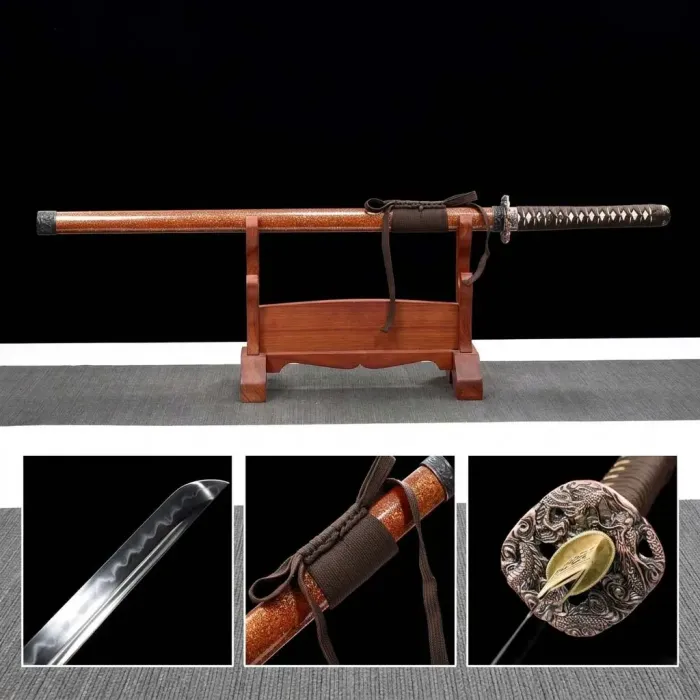
A time-honored oriental sword stands a magnificent display of technique, but what if you strive for to show your separate style? Personalizing your weapon is a profound journey, allowing you to craft a truly unique piece. From the tsuka wrapping and band to the covering design and edge design, each constituent offers a chance for distinctive style. This review delves into the space of katana transformations, providing information for both starters and well-versed enthusiasts looking for to imprint their stamp on the traditional art of the samurai.
Freshman's Authentic Artistry
For starters motivated to embark on the exciting journey of historical swordplay, 1060 steel katanas offer an prime entry point. This specialized grade of elemental steel obtains a perfect balance between expense and proficiency. While never as hard as top-tier steels, 1060 facilitates a fair level of whetting, making it suitable for learners to develop the rudiments of sharpening care and respect the beauty of traditional Japanese weaponry. It’s a wonderful choice for gaining experience without the investment burden of more complex steels.
Type T10 Cutting Tools : Managing Efficiency and Budget
Enabling fans seeking an authentic weapon experience without surpassing the monetary limit , T10 substance katanas represent a appealing option. These armaments offer a marked improvement in resilience compared to less expensive alternatives, exhibiting good edge retention and adequate flexibility for basic incising techniques. While not rivaling the top-notch characteristics of superior steels like T100 or folded iron , T10 provides a notable blend of ability and affordability , making them a popular choice for trainees and those on a controlled earnings .
Transcending the Edge : Enhancing Your Edge's Ornaments and Handle
While the glazed cutting edge is undeniably the main point of a katana, truly elevating its grandeur lies in the deliberate customization of its hardware and hold. This method allows collectors to present their exclusive preference . Assess the ample possibilities: menuki - decorative charms that introduce visual appeal ; the hamon sheaths – often masterfully etched ; the tsuka nucleus itself, wrapped in classic ito rope ; and the fusa butt cap , which can be fabricated from various elements like treasures or antler .
- Prefer concepts that echo with you.
- Test with distinctive elements .
- Concentrate on excellence for a durable effect .
The Allure of the Katana: History, Craftsmanship, and Steel
That Japanese sword exhibits a unique allure, steeped in generations of Pacific Rim history and heritage . More than merely a artificial item of warfare , it's a embodiment of the soldier ethos – a fusion of skill and restraint . Its maturation spanned score generations, with early steel evolving into the polished curvature and precise edge we recognize today. The fabrication involved is truly phenomenal , requiring epochs of training to attain . The process involves a complicated folding of pure iron , creating layers that enhance the cutting edge’s flexibility and carving ability. Assorted schools of smithing arose , each with their unique secrets and approaches for achieving the supreme proportion and cleanness - a truly heavy pursuit.
- Early Katana shapes
- The function of the samurai blade in fighter class culture
- Heritage fabricating systems
Determining the Right Steel for Your Armament Project: 1060 vs. T10
Identifying the favorable steel is absolutely important for any katana project, and the decision between 1060 and T10 can be tricky. 1060 is a frequented American element, offering a competent balance of rigidity and endurance, supplying it comparatively easy to forge. However, T10, a Oriental steel, frequently boasts increased wear durability and can arguably achieve a greater ultimate hardness, although it can be more tough to treat and requires detailed heat annealing. Consider your proficiency and projected results: for a trainee, 1060 may be a safer launchpad, while the seasoned smith might favor the additional details of T10.
- Manageability of Managing
- Abrasion
- Final Stiffness
Unlocking the Potential: Advanced Katana Customization Techniques
Mastering the art of katana alteration extends far beyond basic buffing. Serious smiths are now researching advanced techniques to truly unleash a blade's hidden potential. This includes intricate work with the temper rim, utilizing specialized elements for differential hardening and carefully electing the shape of the crossguard to optimize balance and capability. Beyond purely functional alterations, artisans are increasingly focused on developing unparalleled aesthetic grace, through complex embossing and layered polishes that truly transform a katana into a work of art.
From Raw Steel to Masterpiece: Crafting a 1060 Katana
The journey opens wakizashi with ordinary 1060 material , a tough material far apart the refined katana it will turn into . Skilled bladesmiths practice a complex process of doubling and constructing the base steel, repeatedly tempering it and pounding it to clear impurities and create a steady grain structure. This arduous process, often enduring for stretches , builds the important toughness and malleability characteristic of a standard Japanese weapon . Supplementary heat treatments , including exact hardening and curing , are indispensable to achieve the specific symmetry of sharpness, stability and elegance .- Stacking: Lowers impurities and establishes grain structure.
- Shaping: Designs the steel into the initial blade form.
- Curing: Directs the final hardness and flexibility.
The Ongoing Allure of the Katana: Detailed Survey of Metal and Enhancement
Every traditional katana endures a potent symbol embodying Japanese custom , its draw far surpassing mere combat tools . Forged from a special steel and sometimes featuring intricate motifs , the procedure of creation itself is a honored art. Beyond the primary craftsmanship, the ability to tailor a katana - from the quench mark to the shaft wrapping and fitting - affords for a honestly individual exhibition for both curators and practitioners alike. This combination of historical steelwork and boundless personalization contributes the katana's continued popularity across the globe .
